
About COMPASS
Approach
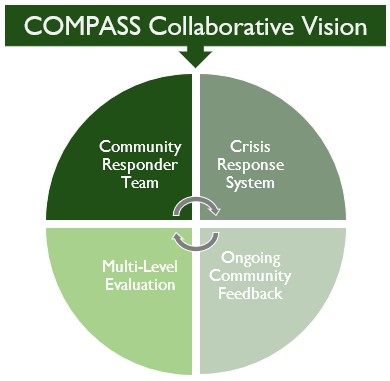
The COMPASS approach to crisis response draws on a vision developed with community stakeholders (see figure at left). Each part of the approach reinforces and supports the other parts.
A community responder team of a social worker and a peer with lived experience responds to mental health and substance use crises seven days a week to complement and support New Haven first responders (police and fire) on 911 emergency calls and through outreach.
COMPASS works with service system providers, advocates, faith leaders, and businesses to improve coordination and integration of services for individuals in crisis.
A standing COMPASS Community Advisory Board of New Haven residents meets regularly to provide feedback to COMPASS leadership and to communicate with the public about COMPASS. The Community Advisory Board ensures COMPASS is responsive to community needs and consistent with community values.
A comprehensive evaluation provides data on quality improvement of the community responder team and the effectiveness of the overall initiative for individuals served, the service system, and the community.
History
In Summer 2020, after the murder of George Floyd, the City of New Haven funded a planning process to develop a new approach to mental health and substance use crises through the 911 emergency response system. Two units of the Connecticut Mental Health Center (CMHC) and the Yale Department of Psychiatry – the Program for Recovery and Community Health (PRCH) and The Consultation Center (TCC) – led the planning process in collaboration with the New Haven Community Services Administration, Department of Community Resilience.
Planning by the Yale team involved participation from a cross-section of New Haven stakeholders, including residents, service providers, and first responders. The Yale team conducted 14 focus groups, three community forums, and two co-design sessions with community stakeholders, many of whom had experienced mental health or substance use emergencies. Over 250 people participated in this process, and 83% reported feeling satisfied that their voices were heard (see the Community Input Report [English or Spanish] and the Evaluation of the Community Engagement Process). In addition, 50 crisis service providers from 35 organizations provided feedback on crisis response by participating in a Sequential Intercept Mapping process (see the report of this feedback here).
The Yale team also sought input from the City of New Haven leadership and first responders, and consulted with the CMHC Mobile Crisis Intervention Unit, CommuniCare, Inc., Continuum of Care, Inc., and the Connecticut Department of Mental Health and Addiction Services (DMHAS). The team also participated in a federal Learning Collaborative on crisis response hosted by the Substance Abuse and Mental Health Services Administration (SAMHSA) The Collaborative provided information on best practices used by community responder programs across the country.
At the conclusion of the planning process, the Yale team developed the current model used by Elm City COMPASS, which consists of four parts: (1) a mobile community responder team to address mental health or substance use crises through trauma-informed care and peer support, (2) multi-sector collaboration to improve the crisis response service system, (3) a standing Community Advisory Board of New Haven residents to ensure COMPASS is responsive to community needs and consistent with community values, and (4) a comprehensive multi-level evaluation to guide decision making for system improvement. Yale managed the overall COMPASS initiative, but retained Continuum of Care to co-manage day-to-day operations of the community responder team. The New Haven Department of Community Resilience, Community Services Administration provided administrative oversight for the Elm City COMPASS initiative.
Timeline: 2022-2026
Overview of Elm City COMPASS & Related Contracts
- May 2022: The City of New Haven contracts with the Yale School of Medicine to conduct a 38-month pilot of Elm City COMPASS through June 2025. The initial contract funds all four parts of the Elm City COMPASS initiative – the community responder team, service system improvements, the Community Advisory Board, and the evaluation. Yale retains Continuum of Care Inc. to co-manage the community responder team.

- May 2024: City of New Haven and the Connecticut Department of Mental Health and Addiction Services contract with Continuum of Care to staff and manage New Haven’s first crisis stabilization center, known as the REST (RapidEvaluation Stabilization and Treatment) Center. Administrative oversight of REST is done through a collaboration of the City and the Connecticut Mental Health Center’s Community Services Network, the local mental health authority funded by the Connecticut Department of Mental Health and Addiction Services. Open 24-hours per day, REST serves as a cornerstone of New Haven’s crisis response service system to divert individuals away from unnecessary arrest or admission to Yale New Haven Hospital’s Emergency Department.
- July 2024: The City of New Haven, with administrative support from the Connecticut Department of Housing, contracts with Continuum of Care to staff and manage a new 100-bed emergency shelter known as the Emergency Housing Program. Residents live in units with a roommate and can stay for 100 days or more as a housing coordinator provides assistance in obtaining permanent supported housing. Nursing, clinical care, and case management services are also available on site.
- July 2025: After a 38-month pilot period, the City approves a one-year no-cost extension of the existing Elm City COMPASS contract with Yale to provide administrative leadership and support for the overall COMPASS initiative. The City initiates a new contract with Continuum of Care to directly manage the community responder team.
- Late 2024-2027: Through a competitive application process, the National Institute of Justice awards Yale a research grant that continues to support the COMPASS evaluation, along with related service system improvements and the Community Advisory Board.

Community Responder Team
- Fall 2022: Protocols and co-training are completed by COMPASS leadership, the COMPASS community responder team, the NHPD, the NHFD, and PSAP (the Public Safety Answering Point that handles 911 calls). Yale designs and manages a data dashboard for use by the community responder team to track services and referrals in real-time.
- Fall 2022-present: Community responder team operations begin with one team on November 1, 2022 from 10am–6pm, 7 days per week. In July 2023, two teams begin operating 7 days per week from 8am–midnight, and in August 2024, three teams begin operating 7 days per week from 8am–3am. Consistent with the original COMPASS model, the team uses two evidence-based practices to assist individuals in crisis: trauma-informed care and peer support.
- Fall 2022-present: Yale completes monthly evaluation reports of team operations, and shares these on the COMPASS website.
- Fall 2022-present: COMPASS establishes effective partnerships with the NHPD, the NHFD, and PSAP to support the NHPD and the NHFD on scene following a 911 call. In August 2023, after protocols are developed in collaboration with the NHPD, the NHFD, and PSAP, COMPASS begins piloting direct response to select 911 calls when there is no public safety threat or medical emergency. In August 2024, updated protocols are finalized with the NHPD, the NHFD, and PSAP to allow direct dispatch of the COMPASS team for certain calls when there is no public safety threat or medical emergency.
COMPASS Service System Improvements
- Winter/Spring 2022-23: COMPASS leadership conducts separate listening sessions and focus groups with service providers, advocates and activists, and faith leaders to obtain input on system improvements for crisis response. The report is completed Fall 2023 (see report) and identifies priorities and next steps for crisis response service system development.
- Fall 2022-present: COMPASS leadership conducts over 150 presentations about Elm City COMPASS and crisis response with New Haven neighborhood Community Management Teams (CMTs), service coordinating committees, behavioral health agencies, healthcare and housing organizations, advocacy organizations, New Haven public library branches, and other community stakeholders.

- Spring/Fall 2023: COMPASS leadership conducts listening sessions about crisis response with local merchant associations and through door-to-door visits with select businesses.
- Winter 2023-24: COMPASS leadership and Community Advisory Board members conduct follow-up listening sessions with service providers, advocates and activists, and faith leaders. These sessions focus on planned service system improvements for crisis response.
- Spring 2023-present: COMPASS establishes effective partnerships with over two dozen key service system partners – service provider agencies, shelters and warming centers, hospitals, Union Station, the CMHC as the local mental health authority, New Haven public library branches, drop-in centers, New Haven navigation hubs, and housing and case management coordinators – to allow for direct access by collaborating agencies to access the COMPASS community responder team directly at their site. This access is designed to prevent 911 emergency calls and avert unnecessary hospitalizations and arrests.
- May 2024-present: With support from the City of New Haven and the Connecticut Department of Mental Health and Addiction Services, Continuum of Care opens New Haven’s first crisis stabilization center, known as the REST (Rapid EvaluationStabilization and Treatment) Center. Administrative oversight of REST is done through a collaboration of the City of New Haven and the Connecticut Mental Health Center’s Community Services Network, the local mental health authority funded by the Connecticut Department of Mental Health and Addiction Services. Open 24-hours per day, REST serves as a cornerstone of New Haven’s crisis response service system to divert individuals away from unnecessary arrest or admission to Yale New Haven Hospital’s Emergency Department.
- July 2024-present: With support from the City of New Haven, and administrative support from the Connecticut Department of Housing, Continuum of Care opens a 100-bed emergency shelter known as the Emergency Housing Program. Residents live in units with a roommate and can stay for 100 days or more as a housing coordinator provides assistance in obtaining permanent supported housing. Nursing, clinical care, and case management services are also available on site.
- Fall 2024-present: COMPASS develops a collaborative protocol between Elm City COMPASS and Youth Mobile Crisis Intervention Services (MCIS), managed by Clifford Beers, Inc., which is responsible for child/youth crisis response. The protocol allows for real-time communication between COMPASS and MCIS during a family crisis and there is a child/youth in need.
- January 2026-present: The City, CMHC, and COMPASS form a Service Integration Work Group to ensure that New Haven residents with multiple service needs – clinical, medical, housing, and psychosocial – receive integrated care across service systems.
COMPASS Community Advisory Board
- Spring 2022: COMPASS receives applications from 85 adult participants in the planning process who express interest in serving as a Community Advisory Board (CAB) member. A seven-person committee reviews applications: the CAB coordinator and co-coordinator, a member of the Board of Alders, two active community members, the COMPASS City liaison, and the COMPASS Director. The committee is diverse as to race, ethnicity, gender, and lived experience of crisis response.
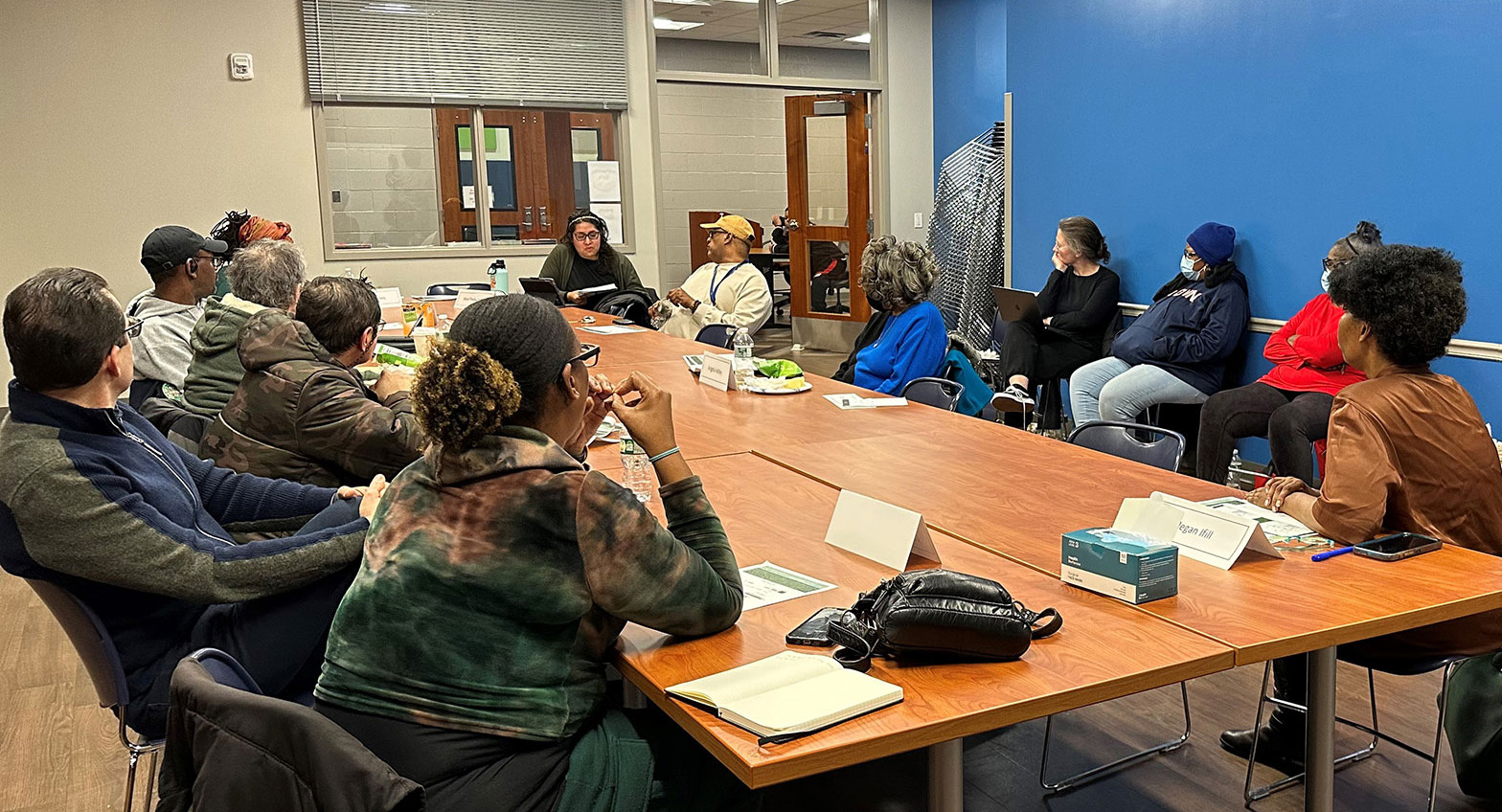
- May 2022: Elm City COMPASS launches the Community Advisory Board (CAB) in May 2022 and welcomes 19 New Haven residents as members. In November 2025, some members leave the CAB after moving out of New Haven or for other commitments, the CAB adds new members; its current membership is 11. Members are representative of New Haven demographically and by neighborhood. Since its inception, the CAB has had three primary goals: 1) to collaborate with COMPASS leadership to set priorities, 2) to provide feedback on COMPASS performance, and 3) to communicate with the public about COMPASS.
- Fall 2022-present: CAB members make critical contributions to COMPASS. Some of these include the following:
- Providing ongoing feedback on COMPASS priorities of its initial strategic vision.
- Advocating with the NHPD and PSAP for direct 911 access to COMPASS.
- Advocating for increased direct access to COMPASS outside of the 911 system.
- Promoting the development of a collaborative protocol for crisis response between COMPASS and child/youth crisis responders.
- Supporting the City’s creation of a community resource directory focused on suicide prevention, which is used by the COMPASS community responder team.
- Co-leading stakeholder listening sessions with service providers, advocates and activists, and faith leaders to identify COMPASS priorities and crisis response service system priorities.
- Advocating for increased City and State funding for crisis response and related housing supports.
- Meeting as a Data and Dissemination Work Group to assist with real-world interpretations of quantitative and qualitative results and evaluation reports of COMPASS.
- Participating in multiple press briefings and other media events to increase public awareness about COMPASS.
- Hosting of dozens of events at neighborhood festivals to inform the public about COMPASS, answer questions about crisis response, and distribute over 2,000 brochures and other resource materials about crisis response, mental health, and addiction.
- Presenting about COMPASS at professional conferences and public meetings.
- Creating videos about their involvement and commitment to COMPASS, crisis response services, and related research.
COMPASS Evaluation
- The Elm City COMPASS evaluation assess the quality of the team’s operations and the effectiveness of the overall initiative at multiplelevels – the individual, the service system, and the community. The evaluation uses a participatory design in which data collection and analyses incorporate the perspective of community stakeholders – New Haven residents, agency partners, Community Advisory Board members, and City leadership. In addition, the design uses mixed methods, quantitative and qualitive, within a multi-level design that includes individual, service system, and community-level assessments.

- At the individual level, the community responder team collects information about the crisis, services received, and immediate outcomes using a data dashboard.
- At the service system level, agency partners are assessed for their views about crisis services and their level of collaboration within the service system. In addition, police data is examined for hospitalizations and arrests.
- At the community level, anonymous interviews with New Haven residents track views of mental health and substance use crises, 911 emergency response and related crisis response services, and Elm City COMPASS.
